

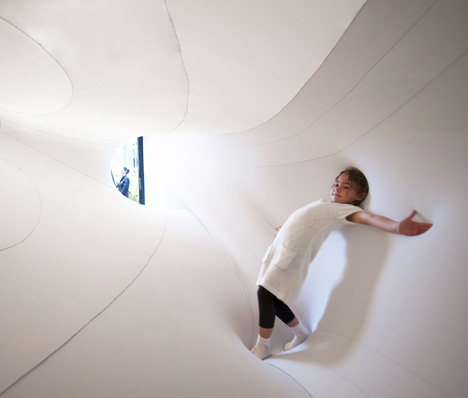
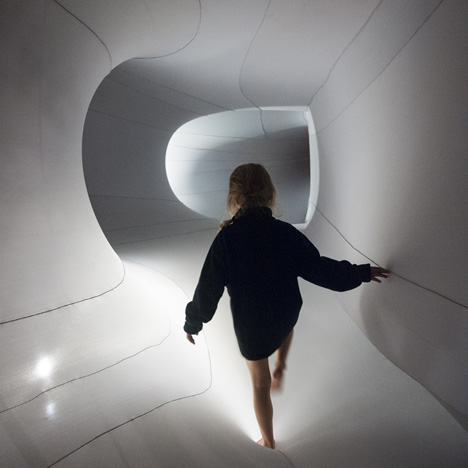
People could immerse themselves in a huge fabric cocoon at this interactive installation by architect and artist Sophia Chang
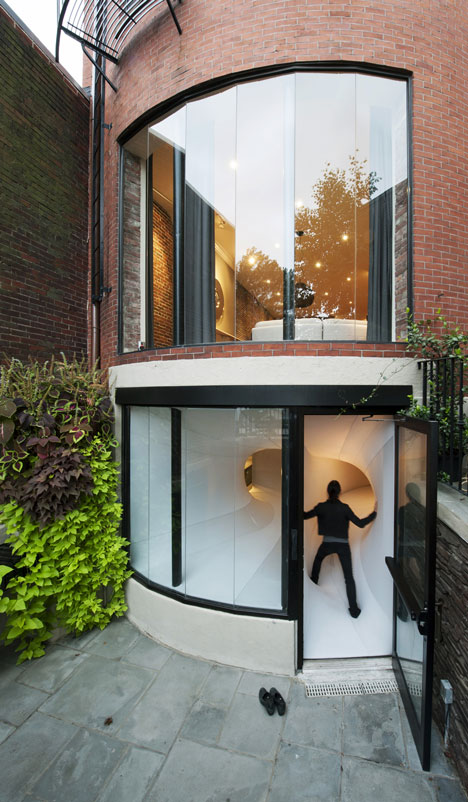
Sophia Chang stretched huge sheets of Lycra around frames to create the network of tunnels and enclosed spaces through the interior of the Invivia Gallery in Cambridge, Massachusetts “The softened geometries of this expansive fabric insertion frame both people and their context, while confounding the experience of interior and exterior, wall and room, hiding and revealing places to be found and explored,” said Chang.
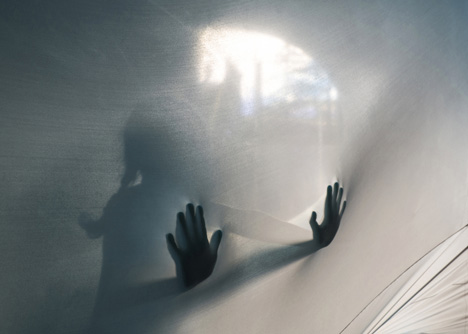
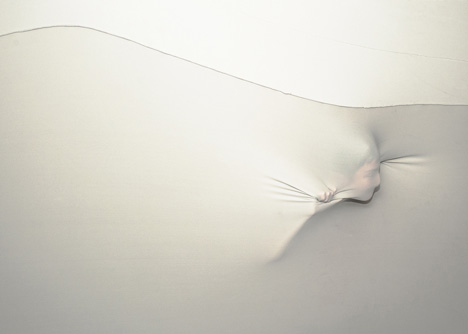
The inside of the space was separated into two disconnected halves. Visitors could occupy either sides, meaning they could see the silhouettes of other people behind the dividing layer of fabric. According to the designer, the experience was intended to represent the feeling of being on the other side of a wall to something unknown – an area known as poché (Frearson, 2013).
While searching for furniture in a tensile environment I found Sophia’s idea. I thought that every inhabitant of my hotel room project could find his own comforting place and use it as a sleeping space, sitting, relaxing and socializing area and even change it whenever he likes it.
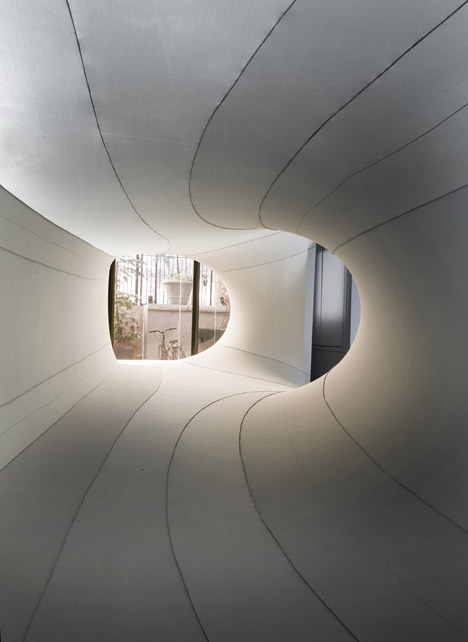
Sophia Chang describes her project Suspense (2013):
‘The installation is conceived as multiple layers of poché. The term commonly refers to the space within walls, here poché receives a more ambiguous reinterpretation: what could be understood as a wall or reminiscent space from one vantage point, becomes an inhabitable room from another. The complexity of the curved forms precludes immediate understanding of the total piece and allows for the visitor’s perception of the space to shift as they continue to discover new places to sit, contemplate, walk, and watch within the gallery.’

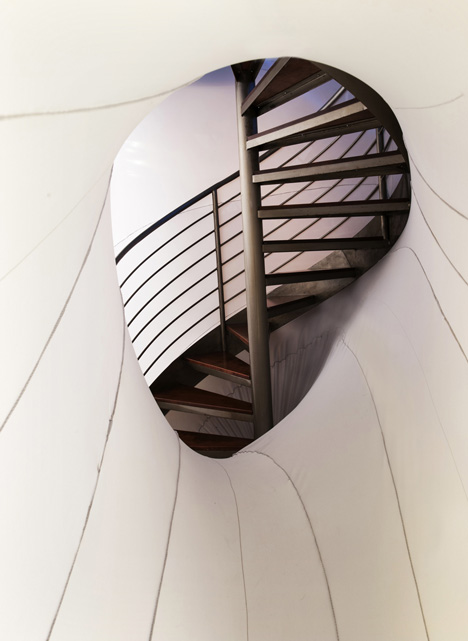
Neighbouring wall spaces are activated as people encounter each other through the fabric. The installation is an ‘open work’ (Umberto Eco) as it is not limited to a single reading or a predetermined range of readings but rather encourages multiple readings. With changes of light, occupation, and the flexing of the geometries, new realisations continuously become possible. (Chang , 2013)
 1826681 alexandrina savova